A specialist website by Oxford Industrial Automation

UK robot & vision integration · 01865 416830

Motion synchronisation

Robot conveyor tracking systems

Keep the camera result aligned with a product after it has moved. Encoder feedback, calibrated conveyor coordinates, product queues and robot scheduling work together to create a usable pick window.

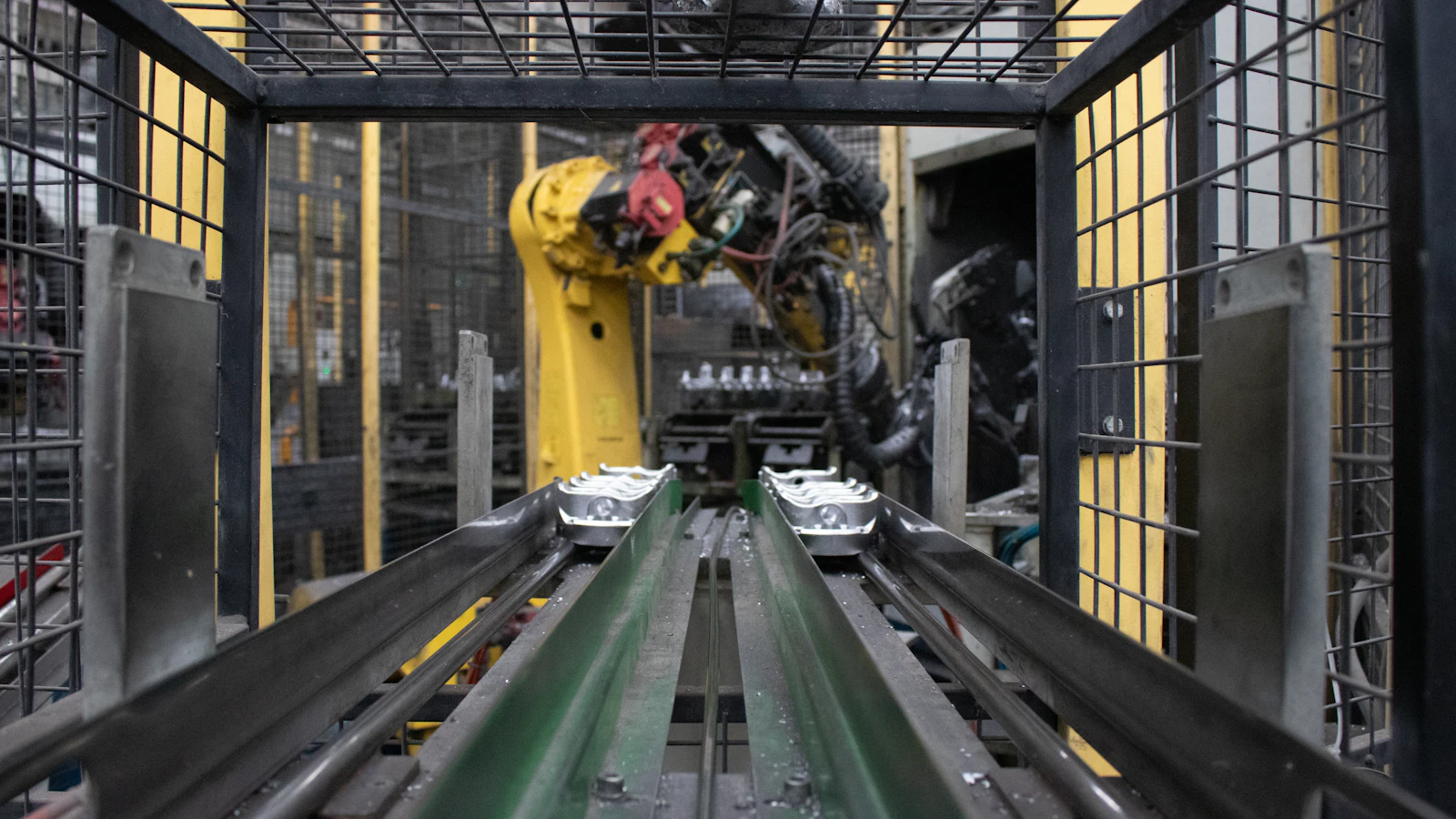
A yellow industrial robot behind metal components on guarded conveyor tracks.
ReferenceEncoder feedback tied to actual conveyor movement
QueueTracked product positions, classes and destinations
WindowDefined pick zone, reach limits and late-pick handling
01 / Engineering focus

Synchronised to the belt, not an assumed speed

An encoder provides a movement reference so tracked coordinates can advance with the conveyor. The design considers belt slip, acceleration, product movement and the distance between imaging and picking.

  • Encoder selection, mounting and scaling
  • Camera-to-conveyor calibration
  • Product registration and queue management
  • Multiple robot load balancing
  • Missed-pick, late-product and line-stop recovery
02 / Engineering focus

Product presentation still matters

Tracking can follow a known target, but cannot create physical separation or a stable gripping surface. Upstream metering, spreading or lane control may be included where the pick window demands it.

  • Minimum and maximum product spacing
  • Overlap and occlusion rules
  • Stable product motion and transfer points
  • Buffering and recirculation options

System sequence

Engineer the complete decision loop.

Every stage is tested against the product, timing, interfaces and agreed response.

01

Measure

Capture belt movement with a correctly scaled encoder.

02

Register

Assign each detection a conveyor position and time.

03

Schedule

Allocate reachable products across available robots.

04

Recover

Define behaviour for stops, slips, misses and restarts.

Typical applications

Where this capability can fit.

Final suitability and performance are confirmed only after review of the complete production application.

Continuous-motion picking
High-throughput sorting
Multiple robot coordination
Dynamic destination selection
Moving-target placement
Tracked reject timing

Application questions

What manufacturers ask.

These answers provide a starting point. Product trials and line data determine the project specification.

Does conveyor tracking require a constant belt speed?

Not necessarily. Encoder-based tracking follows measured movement, including normal speed changes, within the dynamic and timing limits of the complete system.

Can several robots share one conveyor?

Yes. Products can be scheduled across multiple robots based on reach, workload, class and destination. The queue and missed-pick rules must be coordinated centrally or through the selected platform.

What happens after an emergency stop?

Restart behaviour is designed around whether product positions remain valid, whether the belt moved independently and whether re-imaging or clearing is required before automatic operation resumes.

Start with the production task

Show us what the system needs to see and move.

Use the project brief form, or email product photos or video with the target output, current layout and required decision. We will define the next technical step.

Project brief