A specialist website by Oxford Industrial Automation

UK robot & vision integration · 01865 416830

Flexible automation

Vision-guided cobot systems

Combine collaborative robot motion with 2D or 3D vision for flexible inspection, handling and machine-loading tasks. The complete application includes tooling, controls, product presentation and a task-specific safety assessment.

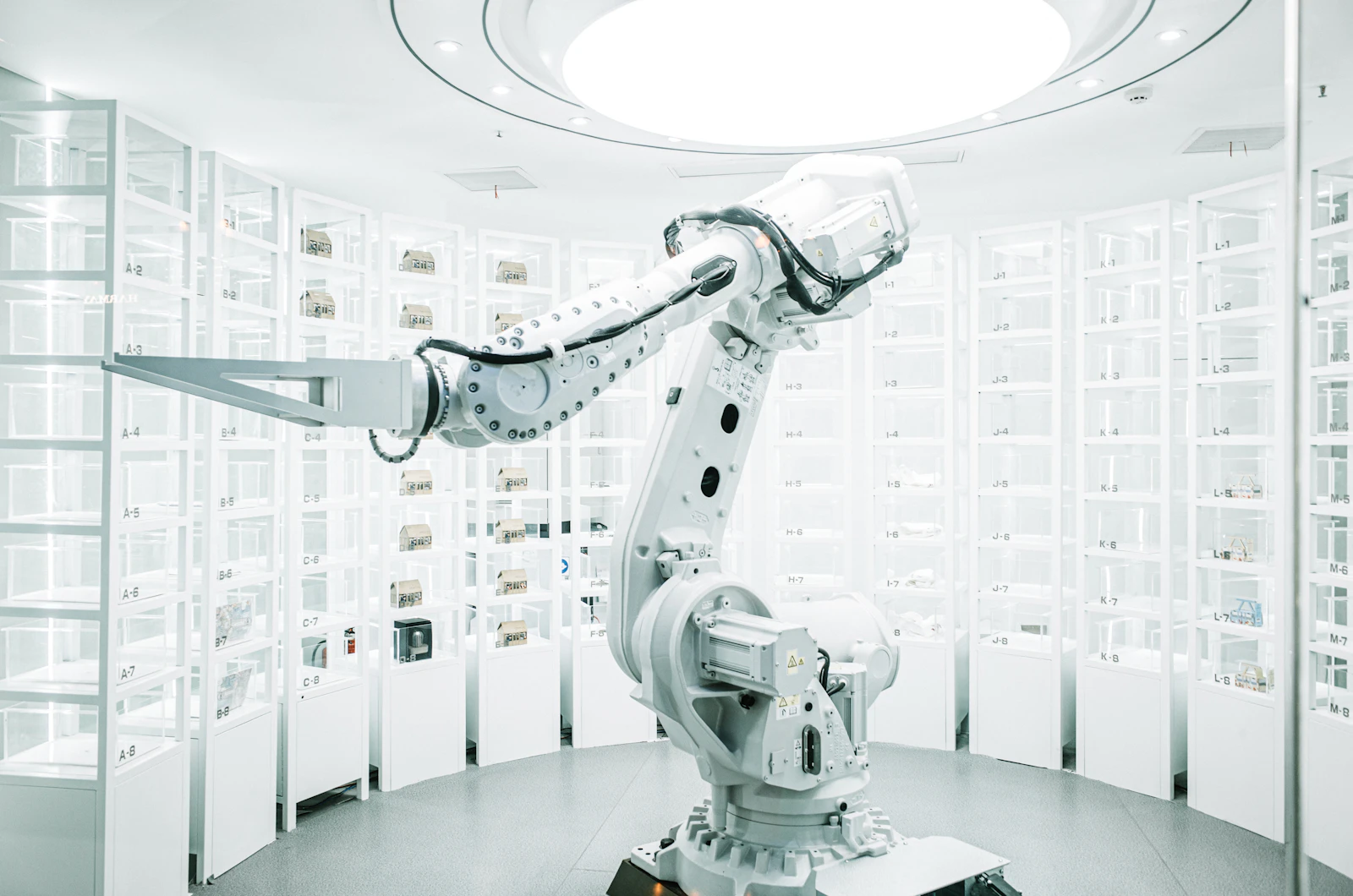
A white industrial robot arm in front of display shelves.
RobotCollaborative six-axis
Vision2D or 3D guidance
UseFlexible handling

Direct answer

What is a vision-guided cobot system?

A vision-guided cobot uses camera results to locate, identify or inspect a product before the collaborative robot performs a programmed action. Vision can reduce the need for rigid fixtures, but the complete cell still needs suitable tooling, cycle-time analysis, controls and risk reduction.

01 / Application fit

Use flexibility where it creates operational value

Cobots can suit mixed-format, lower-volume or frequently changing processes where flexible programming and compact integration matter more than maximum speed. Product variation and operator interaction are considered from the start.

  • Pick, orient and place
  • Inspection from controlled viewpoints
  • Machine loading and unloading
  • Kitting, tray loading and test handling
02 / Safe production

Collaborative does not mean risk-free

The product, gripper, speed, force, reach, surrounding equipment and task determine the safeguarding approach. Some applications can operate collaboratively; others need scanners, guarding or controlled modes.

  • Task-specific risk assessment
  • Tooling and product hazard review
  • Safe access, restart and recovery
  • Integration with machine and line safety

Decision to action

Engineer the complete production loop.

Each stage is designed against representative products, real timing and the required physical outcome.

01

Locate

Find the product, feature or fixture.

02

Decide

Select the recipe, result or destination.

03

Move

Execute the controlled cobot path.

04

Verify

Confirm placement, inspection or process completion.

Application opportunities

Where this capability can fit.

Final suitability follows from the product, presentation, rate, environment and acceptance criteria.

Flexible pick and place
Cobot inspection stations
Machine tending
Mixed-format kitting
Test and measurement handling
Low-volume automation

Questions manufacturers ask

Clear answers before specification.

Use these answers to frame the first application review and the evidence needed next.

Is every cobot application safe without guarding?

No. Collaborative operation depends on the complete task, including the tool, product, speed, contact risk and nearby machinery. The safeguarding strategy follows from a risk assessment.

Can one cobot handle several product formats?

Often, where reach, payload, tooling and presentation support the range. Recipe control and changeover strategy are developed around the real format family.

Can vision be mounted on the cobot?

Yes. A robot-mounted camera can move between viewpoints, while a fixed camera can inspect a stable field. The best arrangement depends on cycle time, calibration and access.

Are cobots suitable for fast conveyor picking?

Some applications are possible, but high-speed continuous picking may favour a delta, SCARA or conventional robot. The required output and timing budget should choose the architecture.

Start with the production task

Show us what the system needs to see and move.

Use the project brief form, or email product photos or video with the target output, current layout and required decision. We will define the next technical step.

Project brief