A specialist website by Oxford Industrial Automation

UK robot & vision integration · 01865 416830

Core application

Vision-guided robotic sorting systems

Identify each product in motion, make the correct routing decision and place it accurately. Oxford Industrial Automation engineers the camera, lighting, tracking, robot, gripper, controls and safeguarding as one production system.

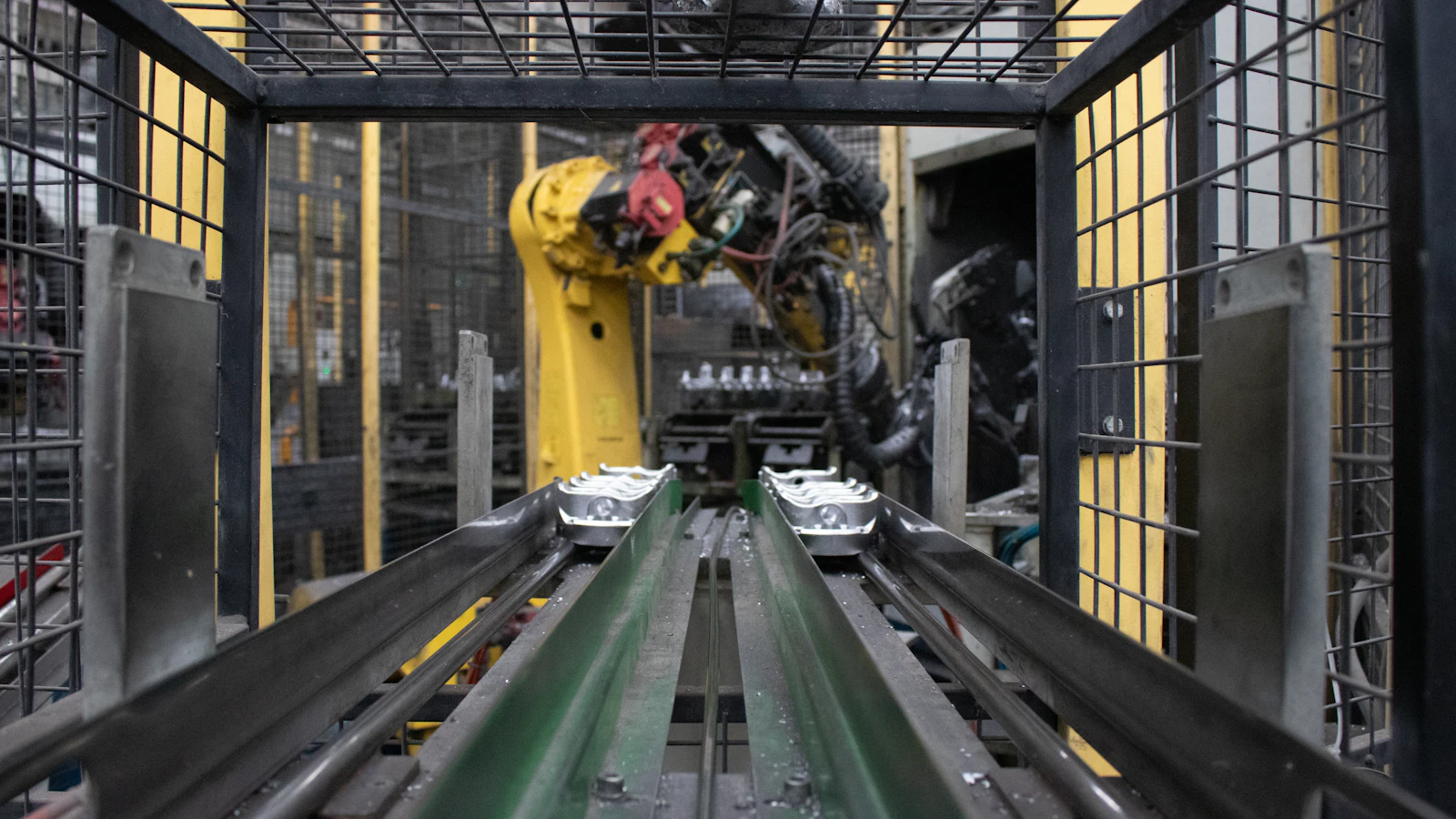
A yellow industrial robot behind metal components on guarded conveyor tracks.
InputLoose, indexed or continuously moving products
DecisionPresence, type, position, orientation or quality
ActionSort, pick, place, divert, reorient or reject
01 / Engineering focus

From image to controlled movement

A reliable system does more than detect an object. It must convert calibrated image coordinates into a stable robot target, keep that target synchronised with line movement and confirm that the final action occurred.

  • 2D or 3D image acquisition matched to the product and task
  • Part localisation, classification and orientation measurement
  • Encoder-based conveyor position tracking
  • Robot path generation and collision-aware placement
  • Pick, place and reject confirmation with fault handling
02 / Engineering focus

Engineered around real product variation

Surface finish, reflections, colour variation, overlap, contamination and inconsistent presentation can all change what the camera sees. Trials use representative product and expected variation so the acceptance criteria are grounded in production reality.

  • Representative good and reject samples
  • Expected product spacing, overlap and orientation range
  • Format recipes and controlled changeover
  • Defined handling of uncertain classifications

System sequence

Engineer the complete decision loop.

Every stage is tested against the product, timing, interfaces and agreed response.

01

See

Create a repeatable, high-contrast image under controlled lighting.

02

Locate

Determine product identity, centre, angle, height or quality state.

03

Track

Maintain the product position as the conveyor continues to move.

04

Act

Pick, place, divert or reject with a confirmed outcome.

Typical applications

Where this capability can fit.

Final suitability and performance are confirmed only after review of the complete production application.

High-speed product sorting
Mixed-product separation
Random pick and place
Quality-led routing
Product orientation
Multi-lane distribution

Application questions

What manufacturers ask.

These answers provide a starting point. Product trials and line data determine the project specification.

Can products be sorted without stopping the conveyor?

Yes, where product presentation, camera exposure, encoder feedback and robot capacity support continuous tracking. We review belt speed, acceleration, spacing and available pick window before confirming the architecture.

What happens when the system is not confident about a classification?

The controls can route uncertain products to a defined reject or manual-review path. Confidence limits and fail-safe behaviour are agreed during application engineering.

Can one system handle several product formats?

Often yes. The practical answer depends on visual differences, size range, gripper compatibility, robot reach and downstream destinations. Recipe-controlled formats can be included in the concept.

Start with the production task

Show us what the system needs to see and move.

Use the project brief form, or email product photos or video with the target output, current layout and required decision. We will define the next technical step.

What defines a useful trial for a vision-sorting system?

Supply the product variation and defect examples the sorter must separate. Agree the categories, accepted-product criteria and the required handling of each output stream. Trials should record both the classification result and the physical sorting outcome so the complete process can be assessed against the production requirement.

Related guidance: Vision Sorting SystemsOxford Industrial Automation · Food vision sorting

Project brief