A specialist website by Oxford Industrial Automation

UK robot & vision integration · 01865 416830

Robotic handling

Vision-guided robotic pick and place systems

Locate products presented at variable angles on a conveyor, choose a stable gripping point and place them into trays, cartons, fixtures or downstream flow. Camera guidance, tracking, tooling and robot motion are engineered as one handling system.

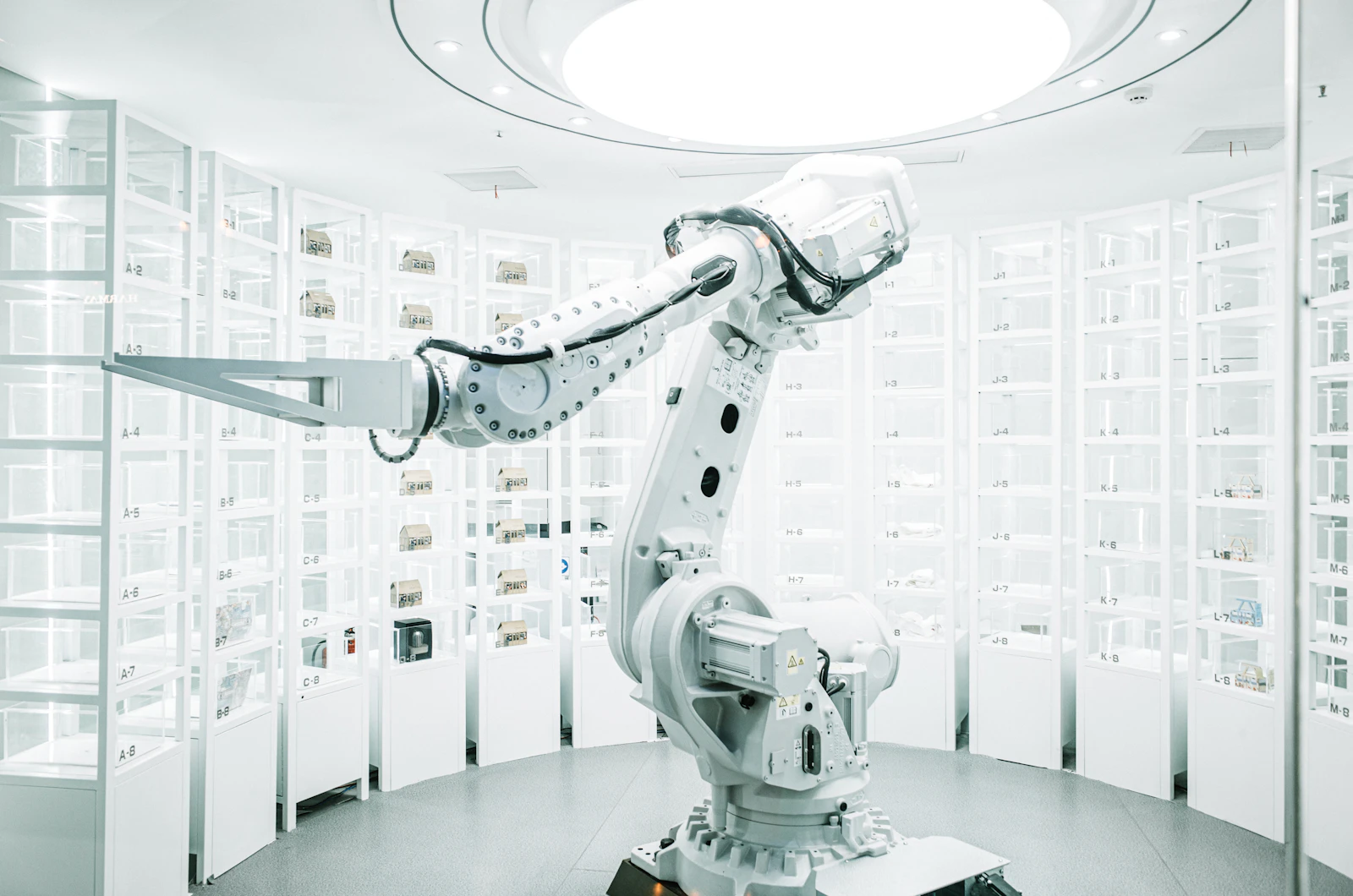
A white industrial robot arm in front of display shelves.
LocateX, Y and rotation; height or pose where required
HandleVacuum, finger, magnetic or application tooling
PlacePack, tray, fixture or downstream conveyor

Direct answer

What is a vision-guided pick-and-place system?

A vision-guided pick-and-place robot uses camera data to locate each product, calculate its position and orientation, select a usable pick point and place it into the required pack, tray, fixture or downstream process. It reduces reliance on rigid product presentation where the application can be proven.

01 / Engineering focus

Accurate placement begins before the robot moves

Camera calibration, product presentation and gripping repeatability determine the quality of the final placement. We assess the complete error chain and the tolerance available at the destination.

  • Camera-guided pick and place from a conveyor or presentation area
  • Rotation, flipping and controlled product pose
  • Placement into trays, pockets, cartons or fixtures
  • Feature-based gripper target selection
  • Multiple destination and pattern recipes
02 / Engineering focus

Tooling designed around the product

A robot can only repeat what the end effector can hold. Product surface, porosity, fragility, centre of gravity and acceptable contact areas shape the tooling concept.

  • Grip-state sensing and vacuum monitoring
  • Product-safe contact materials
  • Quick-change or multi-format tooling
  • Loss-of-product and mis-pick recovery

System sequence

Engineer the complete decision loop.

Every stage is tested against the product, timing, interfaces and agreed response.

01

Locate

Measure the product position and usable pick features.

02

Grip

Secure the product and confirm successful acquisition.

03

Orient

Apply the required rotation, tilt or face selection.

04

Place

Meet the downstream position and release tolerance.

Typical applications

Where this capability can fit.

Final suitability and performance are confirmed only after review of the complete production application.

Random product picking
Tray and pocket loading
Fixture and pattern loading
Product singulation
Face-up orientation
Patterned placement

Application questions

What manufacturers ask.

These answers provide a starting point. Product trials and line data determine the project specification.

Can the robot rotate a product after picking it?

Yes. Rotation can come from the robot axes, a wrist tool, a regrip station or a controlled flip, depending on product geometry, cycle time and the selected robot architecture.

How accurately can a vision-guided robot place a part?

System accuracy depends on image scale, calibration, product localisation, robot repeatability, tooling compliance and destination tolerance. We define and test the complete accuracy requirement for the application.

Can one gripper handle different formats?

Sometimes. Adjustable, compliant or zoned tooling can cover a format family, while larger changes may justify an automatic or manual tool change.

Start with the production task

Show us what the system needs to see and move.

Use the project brief form, or email product photos or video with the target output, current layout and required decision. We will define the next technical step.

Project brief