A specialist website by Oxford Industrial Automation

UK robot & vision integration · 01865 416830

Technology selection guide

2D versus 3D robot vision

Choose the image information the application needs—not the most complex camera available. This guide compares planar 2D imaging with depth and spatial 3D vision for UK manufacturing projects.

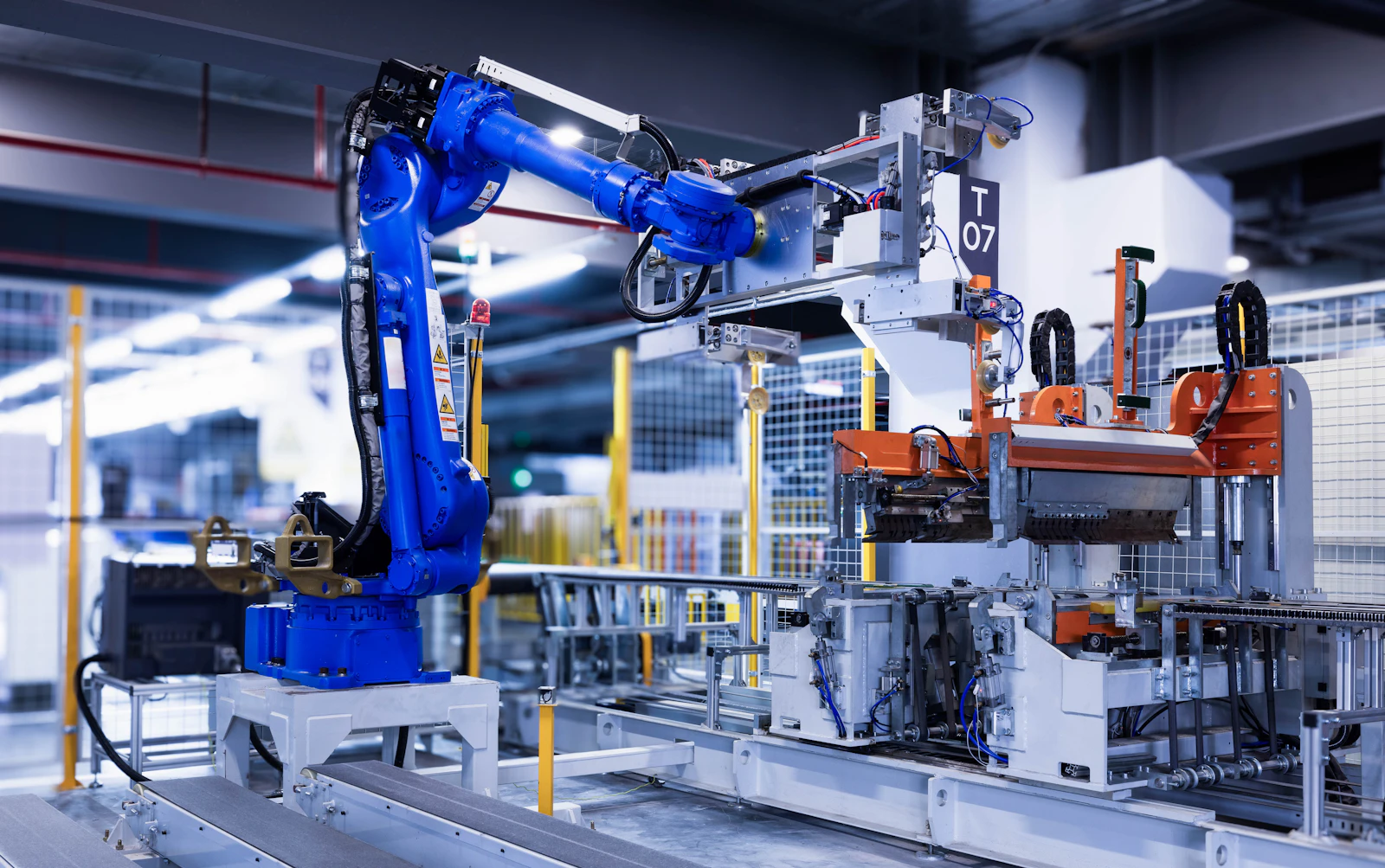
A blue industrial robot arm beside a production fixture.
2DX, Y and rotation
3DDepth and spatial pose
RuleUse only what the task needs

Direct answer

What is the difference between 2D and 3D robot vision?

2D vision analyses a flat image for contrast, shape, colour, code and planar position. 3D vision also measures depth, height or spatial pose. A 2D system can be the better choice when products stay on one plane; 3D is considered when height, tilt, overlap or a full spatial pose affects the robot action.

01 / Choose 2D

Use planar vision for controlled presentation

2D vision can inspect features, read codes, locate objects on a conveyor and calculate planar robot coordinates. It is often easier to light, calibrate, process and maintain where product height is controlled.

  • Flat or controlled product plane
  • Presence, shape, colour and print
  • Barcode, Data Matrix, OCR and OCV
  • Conveyor X, Y and rotation guidance
02 / Choose 3D

Add depth when geometry changes the action

3D methods measure surface height or spatial position. They can support random bin picking, dimensional profiles, depalletising and tasks where the robot must approach a tilted or stacked object.

  • Variable height and tilt
  • Overlapping or bulk-presented parts
  • Height and profile measurement
  • Up to 6-DoF robot pose calculation

Decision to action

Engineer the complete production loop.

Each stage is designed against representative products, real timing and the required physical outcome.

01

Feature

Define exactly what must be detected or located.

02

Variation

List the height, pose, surface and presentation range.

03

Trial

Prove the simplest suitable imaging method.

04

Integrate

Validate calibration, timing and physical response.

Application opportunities

Where this capability can fit.

Final suitability follows from the product, presentation, rate, environment and acceptance criteria.

2D conveyor location
3D bin picking
Planar inspection
Height and profile checks
Code-led robot routing
Spatial robot guidance

Questions manufacturers ask

Clear answers before specification.

Use these answers to frame the first application review and the evidence needed next.

Is 3D vision more accurate than 2D vision?

Not automatically. Accuracy depends on the camera method, optics, calibration, field of view, surface and working distance. The application determines which measurement is meaningful.

Can 2D vision guide a six-axis robot?

Yes when the required target information is planar or when the missing coordinates are otherwise constrained. A six-axis robot does not automatically require a 3D camera.

Can one cell combine 2D and 3D vision?

Yes. A 3D sensor might locate a part while a 2D camera verifies identity or surface detail. The extra complexity should be justified by a clear production requirement.

Which method is better for random bin picking?

3D is usually considered because parts vary in height, tilt and overlap. The exact sensor and grasp strategy still need trials with representative parts and bins.

Start with the production task

Show us what the system needs to see and move.

Use the project brief form, or email product photos or video with the target output, current layout and required decision. We will define the next technical step.

Project brief