A specialist website by Oxford Industrial Automation

UK machine vision & robot integration · 01865 416830

Inspection method guide

AI versus rule-based machine vision

Use the simplest method that proves the quality decision. Deterministic tools remain strong for clear limits; learned models can help where acceptable and defective appearance varies.

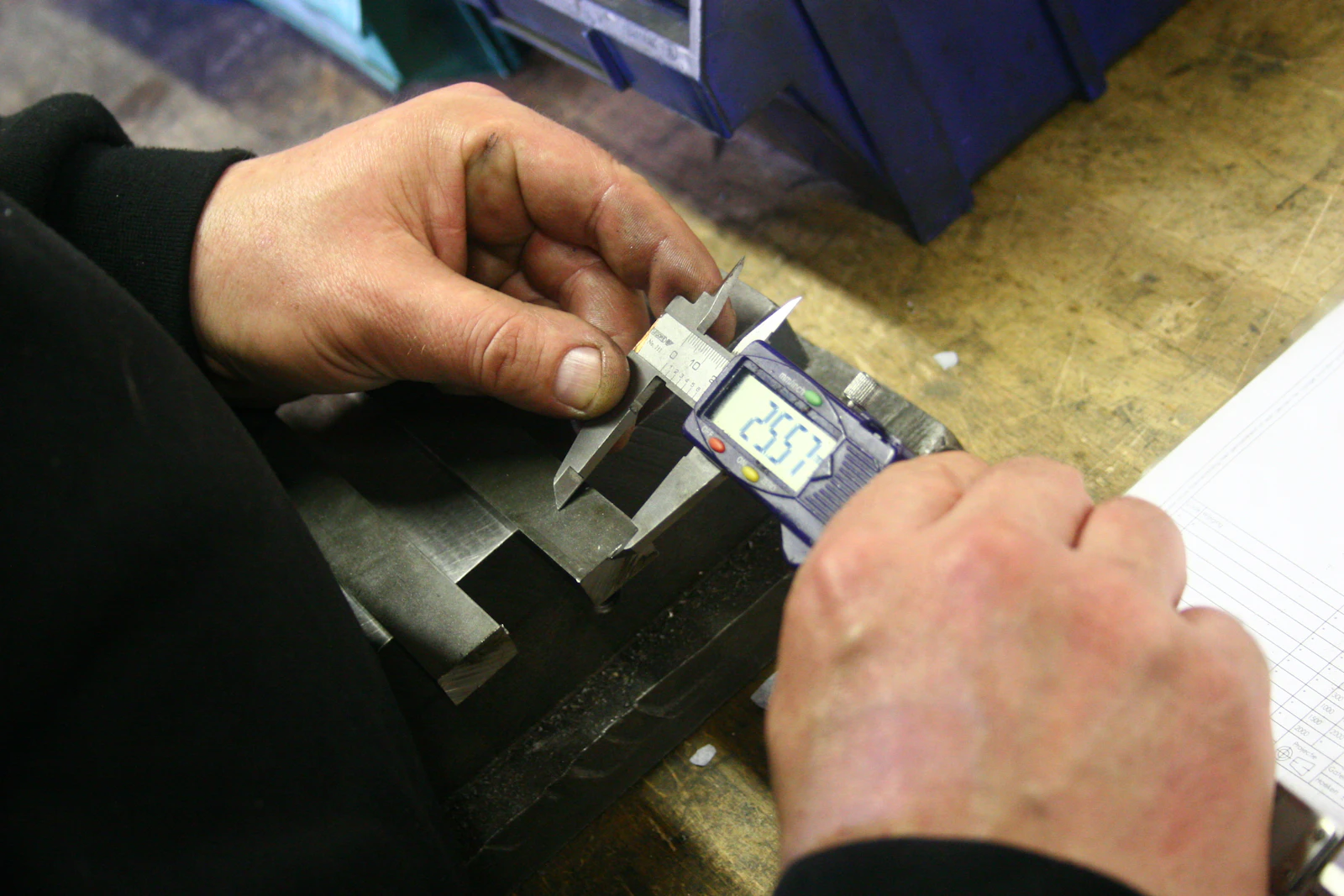
Hands using digital calipers on a metal component.

Manual measurement shown: deterministic tools remain preferable where a clear tolerance can be proven.

RulesMeasurements, presence, position, codes and clear thresholds
AIVariable textures, cosmetic classes and learned appearance
HybridCombine deterministic checks with learned classification

Direct answer

Should an inspection use AI or rule-based machine vision?

Rule-based tools are often the better choice when the decision can be described with a stable measurement, contrast, position, code or tolerance. AI can help when visual variation is hard to express as fixed rules. Many production systems use both, with controlled imaging and explicit uncertainty handling.

01 / Decision type

Use rules where the limit is objective

Presence, distance, angle, edge, diameter, code content and known colour limits are usually easier to validate with deterministic tools. The logic remains transparent and recipe changes can be controlled directly.

  • Dimensional and geometric checks
  • Presence, position and assembly
  • Barcode, Data Matrix, OCR and OCV
  • Known colour or contrast limits
  • Clear pass and reject tolerances
02 / Appearance variation

Use learned methods only when the data supports them

AI can classify or locate irregular scratches, natural product variation, texture and cosmetic appearance that resist a short rule set. The training and validation dataset becomes part of the machine specification.

  • Representative batches, suppliers and formats
  • Good, defective and borderline examples
  • Independent production challenge set
  • False-accept and false-reject priorities
  • Model, label and threshold version control

Side-by-side comparison

Match the method to the production constraint.

Use the comparison as a screening tool; the final architecture follows from representative products, timing and acceptance evidence.

Method comparison. Representative trials should prove the final inspection architecture.
QuestionRule-based visionAI / deep learningHybrid approach
Best fitStable geometry, codes, known tolerances and repeatable contrastVariable cosmetic defects, natural materials and complex textureApplications with both objective checks and learned appearance
Evidence neededFeature visibility, calibration, tolerance and repeatability samplesRepresentative labelled data across real production variationBoth datasets, plus logic defining how results combine
ExplainabilityDirect measurement or programmed ruleModel score, class, region or anomaly resultDeterministic evidence with learned classification where needed
Change controlRecipe, threshold and tool configurationDataset, labels, model, threshold and deployment versionCoordinated versioning of recipes, models and PLC response

Decision pathway

Prove the method before production release.

A model demonstration is not a complete inspection system; image control, validation and containment still decide production performance.

01

Define

Agree defect classes, limits and uncertain-result policy.

02

Capture

Control optics, lighting, trigger and representative variation.

03

Challenge

Test unseen products, rare conditions and borderline states.

04

Control

Version the method and monitor production outcomes.

Questions manufacturers ask

Choosing between AI and rules.

Use these answers to frame the first application review and the evidence needed next.

Does AI vision need perfect lighting?

AI may tolerate some variation, but controlled imaging remains essential. Lighting changes can alter the visual evidence and reduce the reliability of both learned and rule-based methods.

How many training images are required?

There is no reliable universal number. Coverage of the true production range, defect classes, suppliers, formats and borderline conditions matters more than a headline image count.

Can AI detect defects it has never seen?

Anomaly methods can flag images that differ from a representative normal set, but an unseen defect should not be assumed detectable without challenge testing and a defined review policy.

Can the methods be combined?

Yes. A system may use deterministic measurement and code reading alongside learned classification or segmentation, then combine the results into one controlled production decision.

Start with the production evidence

Show us the production task and required outcome.

Use the project brief form, or email representative product images or video with the target output and required decision. We will define the next technical step.

Project brief